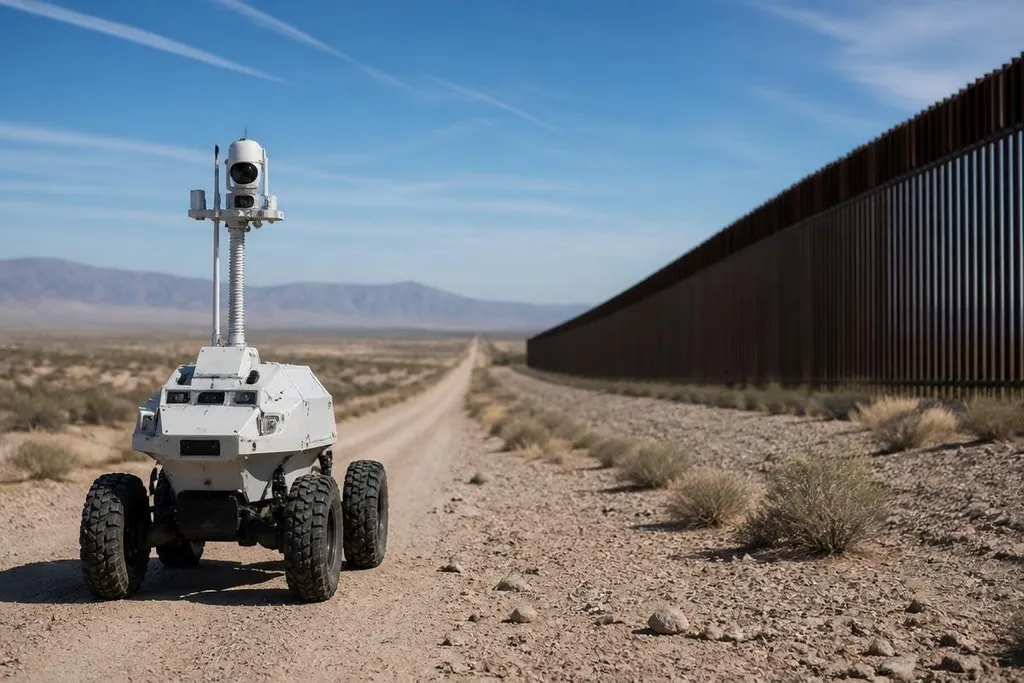
A patrol robot can keep a camera pointed at a fence line, road, or remote crossing for hours. It can send video and sensor data to an operator without putting that person in the same place. The hard part starts when software must decide what the scene means.
Quick read
- Thermal cameras detect heat that a normal camera may miss at night.
- Remote control keeps a person in the decision loop.
- Power, radio links, terrain, and false alarms limit useful coverage.
What the robots actually do
Border security robots usually combine a moving base with cameras and other sensors. A wheeled or tracked robot can follow a set route, stop at planned points, and send live video to a control room.
An autonomous system makes some movement choices on its own. It may follow mapped paths, avoid objects, or return to a charging point. Those tasks are narrow. They don't give the robot a reliable way to judge intent, identity, or danger from a single image.
The sensors do different jobs. A visible-light camera records ordinary video. A thermal camera records heat, which can help an operator see a person or vehicle in low light. LiDAR measures distance with laser pulses and builds a range map around the robot.
That data becomes useful when software joins it into one view. A person may then see a vehicle on a road, its distance from the robot, and a heat trace beside it. The system still needs a human to check the image and decide what action follows.
Why the approach attracts attention
A robot can repeat a patrol route without asking a guard to walk the same ground each time. It can also place a camera closer to a steep slope, rough track, or other area that takes more effort to watch from a vehicle.
The value depends on the task. A machine that sends a clear alert for a broken fence may help an operator focus on that location. A system that sends alerts for every animal, branch, shadow, and heat source can add work instead.
Drones add a different kind of coverage. They can move over ground vehicles can't reach quickly, then return when their battery runs low. That makes them useful for short checks, though flight time, weather, air rules, and the radio link set firm limits.
Those limits need the same detail as the claimed reach: patrol route, battery time, radio range, weather, and the operator’s role. Border robotics reports from Robot24.com can tie those facts to the robot’s task, giving the next section a clear starting point: where the system stops working.
Where the limits appear
Radio range is a practical limit. Hills, buildings, weather, and local interference can weaken the link between a robot and its operator. A lost connection should trigger a safe stop or return route, and the system should record what happened.
Power creates another limit. Motors, cameras, computers, and radio equipment all draw energy. A robot that spends much of its shift returning to charge may cover less ground than its route map suggests.
Terrain matters just as much. Wheels may work well on a maintained road and struggle on loose soil. Tracks can cross rougher ground, but they add weight, noise, and maintenance needs. A drone avoids some ground problems while taking on wind and flight restrictions.
Software can also make a wrong call. Heat does not prove identity, and movement does not prove intent. I'd treat any claim of fully automatic border decisions as unproven until a named system, field test, and error record are available.
Privacy and oversight need attention from the start. Video retention, access rights, facial recognition, and data sharing should have clear rules before a robot begins patrols.
Without those rules, better sensing can create a larger record of ordinary people moving through public areas.
Before a purchase or trial
A useful review should begin with the job, then test the whole system around that job.
- Name the patrol task. Write down the route, sensor need, response time, and person responsible for each alert.
- Test the radio link. Check video and control at the farthest point, behind terrain, and during poor weather.
- Measure false alerts. Run the robot past normal traffic, animals, vegetation, and empty paths to see what it reports.
- Check recovery behavior. Confirm what happens after a blocked route, low battery, sensor fault, or lost connection.
- Set data rules. Decide who can view recordings, how long they remain stored, and when they must be deleted.
- Price the full service. Include charging gear, repairs, software, training, network access, and staff time.
The next useful proof will come from field records that show coverage, alert accuracy, downtime, and operator workload over a full patrol period.
Until vendors publish those details for named systems, border robots are best judged as remote sensing tools with human review, not as automatic decision-makers.